
Culture and learning
Culture influences how we learn, communicate, and interact. In a glocal (global + local) classroom, cultural diversity is a strength - but it also requires intentional pedagogical approaches. This page introduces key concepts and strategies to support inclusive and culturally responsive education, helping you navigate complexity, encourage belonging, and promote equitable learning for all your students.
What is culture?
Culture is a dynamic and multifaceted concept that shapes how we learn, communicate, and interact. It encompasses the shared values, beliefs, behaviours, and practices of a group, and influences how individuals perceive themselves and others in educational settings.
Culture is defined as the learned and shared values, beliefs, and behavior of a group of interacting people. — Bennett (2004)
Understanding culture is essential for inclusive and responsive learning environments. It allows you to move beyond assumptions and engage with your learners in ways that harness and celebrate their diverse backgrounds and experiences. This approach reflects the ambitions of KI Strategy 2030, which emphasises global collaboration, equitable education, and the development of learning environments that are inclusive, innovative, and socially responsible.
Why does culture matters in learning?
Culture plays a foundational role in shaping how individuals learn, communicate, and engage in educational spaces. It influences learner needs and expectations, communication practices, perceptions of authority and collaboration, language use and interpretation, and values, attitudes and beliefs about education.
Cultures of teaching and learning
Let's explore the idea of expectations and how they shape teaching and learning in different contexts. These expectations are not static or universal; they are shaped by historical, social, and institutional factors, and they vary across regions, disciplines, and communities. Recognising there are different cultural expectations allows educators to reflect on their own assumptions and better understand the diverse experiences that students bring to the classroom.
One way to think about how culture shapes expectations and practices in a given learning space is shown in the figure below.
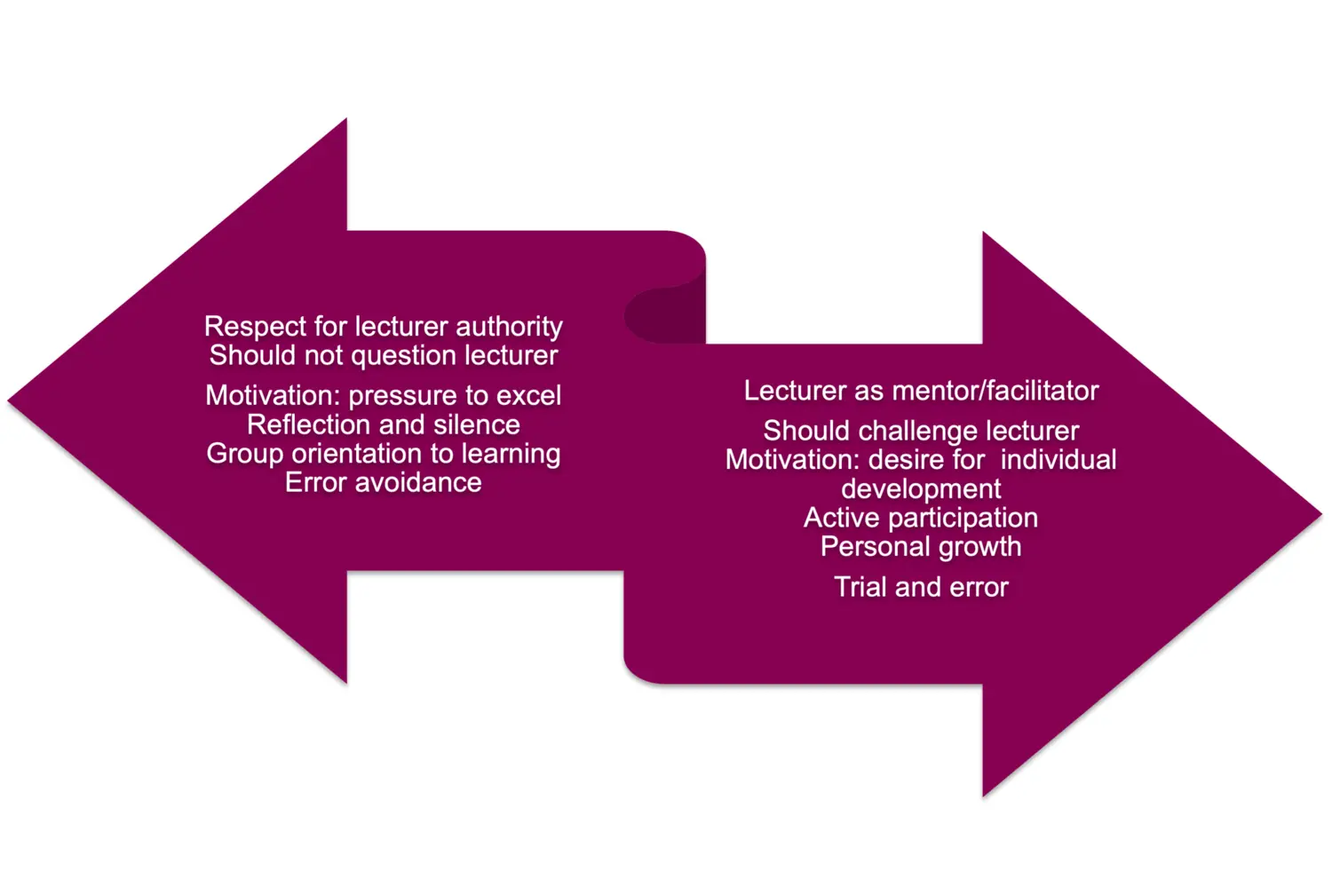
On one end, learning is guided by norms such as respect for lecturer authority, structured approaches, and a strong motivation to excel through reflection and error avoidance. These practices can foster discipline, rigour, and collective responsibility. On the other end, norms around learning emphasise that the lecturer is a mentor or facilitator, students are encouraged to challenge ideas and to engage actively. Motivation here stems from personal growth and individual development, with trial and error and dialogic exchange supporting autonomy and critical thinking.
Let's take a closer look at what this means for our llearning spaces.
Learner needs and learner expectations
Learners from different cultural backgrounds may approach education with varying preferences. Some may feel more comfortable in collaborative settings, while others may prefer working independently. Similarly, preferences for structured versus flexible environments, or reflective versus active participation, can differ across cultural contexts. These variations reflect diverse educational traditions and values, and recognizing them allows you to design learning experiences that are inclusive, responsive, and respectful of all learners (Naylor et al., 2021).
Communication practices
Cultural norms shape how individuals express themselves and interpret meaning. In high-context cultures, much of the communication relies on non-verbal cues, shared experiences, and implicit understanding. Messages are often indirect, and meaning is derived from context, relationships, and tone. In contrast, low-context cultures prioritise explicit verbal exchange, where clarity and directness are valued, and meaning is conveyed primarily through words (Ingraham, 2010).
Perceptions of authority (power distance) and collaboration
Educational cultures vary in how they approach the roles of teachers and learners. In some contexts, educators are viewed as respected authorities whose guidance is central to the learning process, and questioning may be less common. In others, teaching is framed as a collaborative and dialogic exchange, where learners are encouraged to engage critically and contribute actively. These differences reflect diverse cultural values around hierarchy, autonomy, and the nature of knowledge - and understanding them can help you encourage respectful and inclusive classroom dynamics (Zhu et al, 2010).
Language use and interpretation
Language is deeply tied to cultural identity and influences how learners express themselves, interpret meaning, and engage with academic content. In multilingual classrooms, students may navigate multiple linguistic and cultural frameworks, which shape their sense of belonging and participation. Recognising language as more than a communication tool - one that carries identity, emotion, and social meaning - can help you encourage inclusive and affirming learning environments (Forbes & Rutgers, 2021).
Values, attitudes and beliefs about education
Learners’ motivation and classroom behaviour are shaped by culturally embedded values and beliefs. For example, some students may prioritise group harmony and collective success, while others may be driven by individual achievement and personal growth. These orientations reflect broader cultural perspectives on education, success, and social roles - not deficits or advantages. Understanding these differences allows you to design learning experiences that resonate with diverse student motivations and encourage equitable engagement (Salili et al., 2001).
Culturally responsive pedagogy and cultural competence are not add-ons, they are integral to effective teaching in diverse classrooms. Moreover, developing cultural humility, a lifelong commitment to self-reflection, openness, and respect for others’ lived experiences, enables all of us to move beyond assumptions and create spaces where all our learners feel seen, heard, and valued.
Cultural humility is a process that requires humility as individuals continually engage in self-reflection and self-critique as lifelong learners and reflective practitioners. It is not a discrete endpoint, but a dynamic and ongoing commitment to understanding one’s own cultural identity, recognizing and challenging power imbalances, and building respectful partnerships based on mutual trust.
What are key cultural concepts?
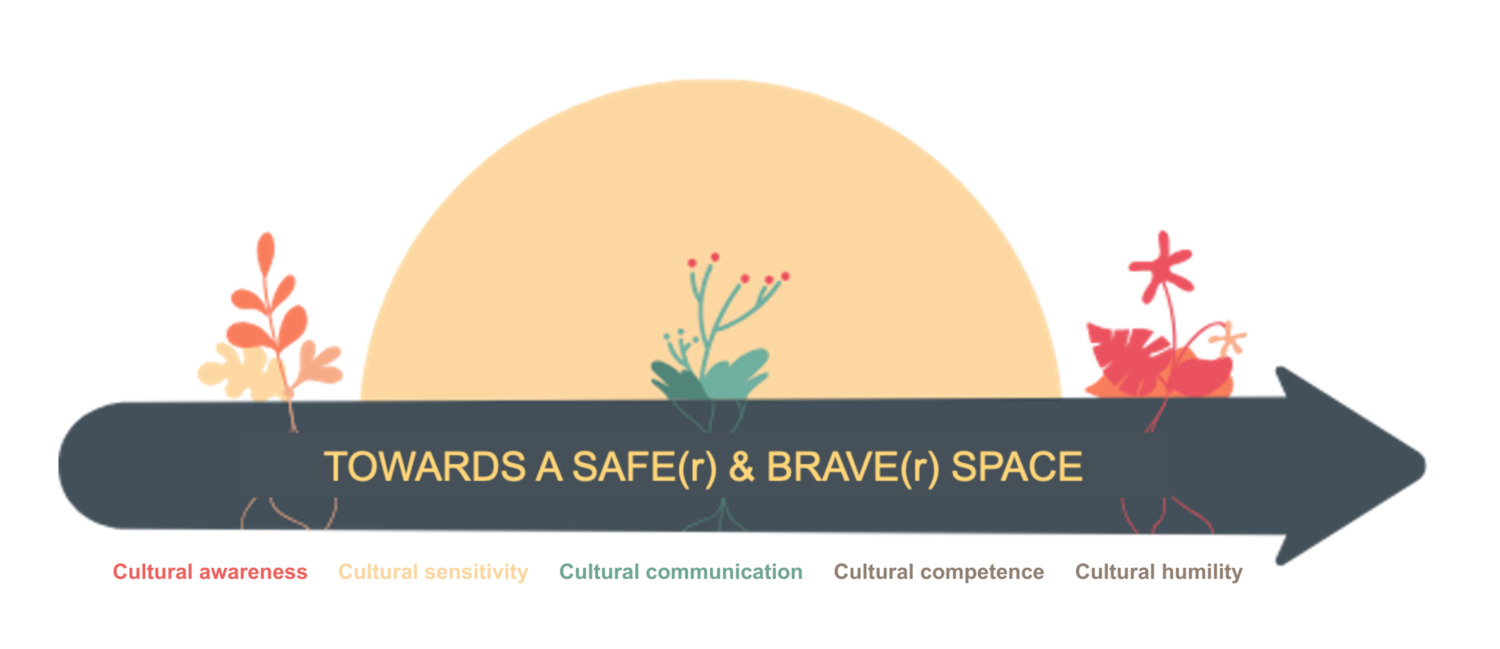
To design and encourage inclusive and responsive learning environments, you must engage with a continuum of cultural dimensions. These five interrelated concepts - cultural awareness, sensitivity, competence, communication, and humility - can be viewed as stepping stones toward deeper cultural understanding, inclusion and equity in education. Rather than discrete skills, they represent an evolving mindset and practice that supports respectful engagement across cultures.
Cultural awareness
Cultural awareness is the foundational step in developing cultural understanding (Hammond, 2015). It involves:
- Recognising that culture shapes how people think, behave, and learn.
- Reflecting on one’s own cultural identity, including how personal experiences and social norms influence perceptions.
- Acknowledging bias and assumptions, and understanding their impact on teaching and learning.
Cultural sensitivity
Cultural sensitivity builds on awareness and emphasises respectful engagement (Musunuri, 2024). It includes:
- Being open to cultural differences without judgment, recognising that diverse perspectives enrich learning environments.
- Adapting communication and behaviour to foster inclusive and respectful interactions.
- Avoiding stereotypes and seeking to understand individuals within their multifaceted cultural contexts, rather than relying on generalisations.
- Acknowledging and addressing implicit or unconscious bias, which can subtly influence decisions, interactions, and expectations. This involves ongoing reflection and a willingness to challenge one’s assumptions.
Cultural communication
Cultural communication highlights how culture shapes the way we express and interpret messages (Zusho & King, 2024). It includes:
- Understanding verbal and non-verbal cues - such as tone, silence, hand gestures, and eye contact.
- Recognising communication styles - such as direct communication vs. indirect communication.
- Practicing active listening and empathy.
Cultural competence
Cultural competence is the ability to work effectively across cultures (Arasaratnam-Smith & Deardorff, 2022). It involves:
- Developing cultural knowledge and understanding.
- Practicing empathy, flexibility, and conflict resolution.
- Cultivating attitudes of curiosity, respect, and humility.
Cultural humility
Cultural humility is a lifelong commitment to learning and self-reflection (Tervalon & Murray-García, 1998.). It emphasises:
- Positionality and power awareness.
- Openness to others’ lived experiences.
- Learning from, rather than about, others.
- Commitment to equity and inclusion.
Cultural humility challenges individuals to embark on a lifelong course of self-examination and transformational learning that will enable them to engage more authentically with clients, patients, colleagues, and others.
How to work with culture in teaching and learning?
Working with culture in education means creating space for reflection, dialogue, and inclusive practices that recognise how identity, power, and context shape learning experiences - especially in healthcare settings. Here are some teaching and learning activities you might like to consider.
Cultural identity mapping
- What: Learners create visual maps of their own cultural identities, using these resources: self-identity mapping, cultural genograms, cultural competence check-ins, and organisational and individual self-assessment tools.
- How: Include aspects like language, values, traditions, and social roles.
- Why: Promotes self-awareness and reflection on how culture shapes perspectives and interactions.
Patient narrative analysis
- What: Analyse real or simulated patient stories from diverse backgrounds.
- How: Focus on cultural factors influencing health beliefs, communication, and care decisions.
- Why: Builds empathy and understanding of culturally grounded health experiences.
Role-play and case-based learning: Clinical encounters across cultures
- What: Simulate clinical scenarios or use case studies involving patients from different cultural backgrounds.
- How: Include interpreters, family dynamics, and culturally specific health practices.
- Why: Enhances communication skills and cultural sensitivity in clinical settings.
Bias reflection discussions
- What: Facilitate discussions using tools like Project Implicit by Harvard University and its Implicit Association Test.
- How: Combine personal reflection with group discussions on unconscious bias and its impact on healthcare provision.
- Why: Encourages critical thinking and bias mitigation strategies.
Community engagement projects
- What: Partner with local communities to address health disparities.
- How: Students co-design health education or outreach initiatives with community members.
- Why: Promotes experiential learning and cultural humility through real-world collaboration.
Interprofessional cultural dialogues
- What: Facilitate discussions among students from different health professions on cultural challenges in care, as described in this guide to effective Interprofessional Education
experiences in Nursing education. - How: Use guided questions and shared case studies.
- Why: Builds collaborative skills and shared understanding across disciplines.
Reflecting on power and privilege
- What: Learners reflect on their own identities and how these relate to societal norms and power structures, such as this activity on health equity and disparity in Occupational Therapy in the CLILMED guidebook (page 36).
- How: Use the Wheel of Power and Privilege to identify aspects of identity (e.g., race, gender, language, ability, education, etc).
- Why: Encourages deep reflection on positionality and privilege at personal and systems level.
Related educational resources
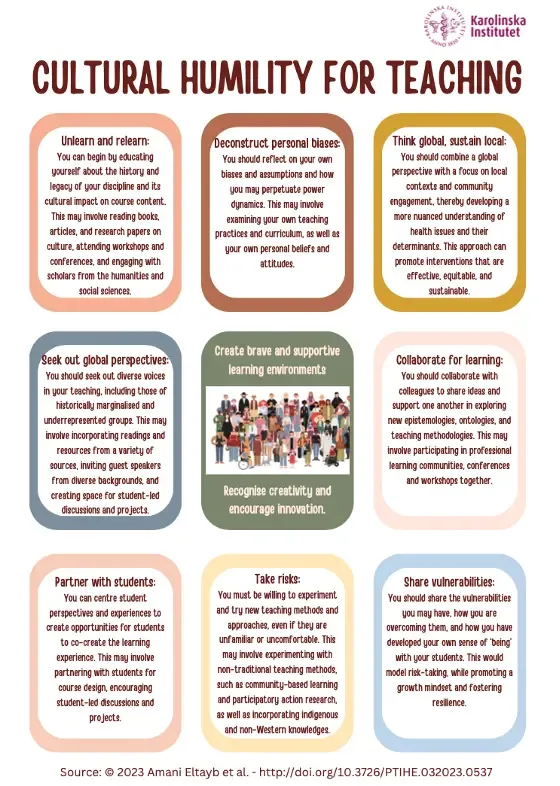 Photo: Jennifer Valcke
Cultural humility for teaching
Guidance for educators on integrating cultural humility into teaching through self-reflection, inclusive practices, student partnership, and community engagement.

Teaching in the glocal university
An introduction to the main issues surrounding teaching and learning at an international university.
The course will enable participants to reflect upon their current teaching practices, while gaining a better understanding of their students, their backgrounds and needs.
 Photo: Getty Images.
Two2Tango, tandems for teaching in the glocal classroom
This course is intended for teachers who wish to develop their teaching skills and their intercultural awareness for teaching the international classroom in English.