

Constructive alignment
Clear and constructively aligned teaching ensures that what students learn, how they learn it, and how their learning is assessed all work together coherently. This page explains constructive alignment and provides practical guidance for designing aligned courses and programmes.
What is constructive alignment?
Constructive alignment (CA) is one of the most influential frameworks in educational design, developed by Professor John Biggs in the 1990s. It represents an outcomes-based approach to curriculum design rooted in constructivist learning theory, where learning is understood as something students actively construct rather than passively receive.
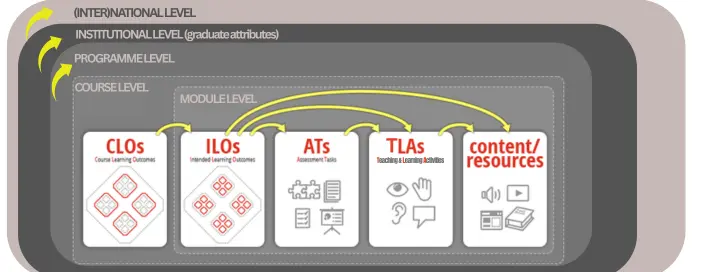
At its core, constructive alignment creates coherence across three essential components:
- Intended Learning Outcomes (ILOs): What students should know, understand, and be able to do by the end of a module or course
- Teaching and Learning Activities (TLAs): The activities and experiences that help students develop the knowledge and skills described in the ILOs
- Assessment Tasks (ATs): The methods used to evaluate whether students have achieved the ILOs

The key principle is that the verbs in your learning outcomes guide both your teaching activities and your assessment methods. For example, if your ILO states that students should be able to "critically evaluate" treatment options, your teaching activities must provide opportunities to practise critical evaluation, and your assessment must require students to demonstrate this skill - not merely recall or describe treatments.

A practical example
Imagine you're designing a module on evidence-based practice in physiotherapy:
- ILO: "Critically appraise randomised controlled trials (RCTs) to inform clinical decision-making"
- TLA: Students work in small groups analysing published RCTs, identifying methodological strengths and limitations, and presenting their appraisals to peers
- AT: Students receive an unfamiliar RCT and write a structured critical appraisal addressing study design, bias, applicability, and clinical implications
Notice how the verb "critically appraise" appears throughout - students practise appraising during teaching, and demonstrate appraising in assessment. This creates a coherent learning experience focused on developing this specific skill.
Applying constructive alignment at multiple levels
Constructive alignment operates across four levels of curriculum design:
Module level: Individual teaching sessions align activities and informal checks with specific learning outcomes for that session.
Course level: The ILOs, TLAs, and ATs for an entire course work together coherently. Each course component contributes to overall course outcomes.
Programme level: Individual courses align with programme-level outcomes. For programmes leading to professional qualifications, this ensures graduates meet the competencies required for practice.
Institutional level: Programme designs reflect institutional educational values and quality standards, supported by policies, staff development, and quality assurance processes that enable constructive alignment.
If students are to learn desired outcomes in a reasonably effective manner, then the teacher's fundamental task is to get students to engage in learning activities that are likely to result in their achieving those outcomes... It is helpful to remember that what the student does is actually more important in determining what is learned than what the teacher does.
Why use constructive alignment?
Constructive alignment offers several important benefits for both teachers and students (Valcke at al., 2025):
Promotes deep, student-centred learning
When teaching activities and assessments genuinely reflect the intended outcomes, students focus on understanding and applying knowledge rather than surface memorisation. Students can see the purpose of what they're learning and how each component connects.
Increases transparency and fairness
Constructive alignment makes expectations explicit. Students know from the outset what they need to achieve and how they'll be assessed. This transparency supports equitable learning, as all students—regardless of background—understand the requirements.
Improves teaching efficiency
When ILOs clearly state what students must achieve, it becomes easier to design targeted teaching activities and select appropriate content. You can focus teaching time on what truly matters, rather than covering content that isn't directly relevant to learning outcomes.
Enables meaningful evaluation
Concrete, observable learning outcomes make it possible to genuinely assess whether students have achieved what the course intended. Course evaluations become more informative when students can reflect on specific, well-defined outcomes.
A practical example
Consider a traditional lecture-based pharmacology module where students attend lectures, read textbook chapters, and sit a multiple-choice exam testing drug name recall. Now redesign it using constructive alignment:
ILO: "Select appropriate pharmacological interventions for common clinical presentations, justifying choices with reference to mechanism of action, efficacy, and safety"
TLA: Case-based learning sessions where students work through clinical scenarios, discuss treatment options, and justify their reasoning to peers
AT: Modified essay questions presenting clinical cases requiring students to select and justify pharmacological management
The above example focuses students' energy on the higher-order thinking (selecting, justifying) that clinicians actually need, rather than passive recall.
The students are 'entrapped' in this web of consistency from which they cannot escape without learning. Constructively aligned teaching is more likely to be effective than unaligned teaching because there is maximum consistency throughout the system... All components in the system address the same agenda and support each other.

How does constructive alignment contribute to quality?
Constructive alignment enhances educational quality in several interconnected ways:
Supports systematic quality assurance
Learning outcomes provide transparent standards for comparison and quality assurance at module, course, and programme levels, and enable national and international comparability. When ILOs are clear and assessable, it becomes possible to monitor whether teaching genuinely facilitates the intended learning.
Shifts focus to student achievement
Constructive alignment centres quality conversations on student learning rather than teacher performance or content coverage. The vital question becomes "What can students do by the end?" rather than "What did we teach?" This student-centred perspective helps educators facilitate and support learning more effectively.
Enables evidence-based improvement
When learning outcomes are observable and measurable, you can examine whether students actually achieve them. This evidence can inform course revisions, teaching development, and programme-level curriculum mapping to sustain coherence over time.
Maintains academic standards whilst allowing flexibility
Critics rightly caution that overly rigid adherence to alignment can hinder flexibility and creativity - essential values in higher education. Contemporary approaches to constructive alignment emphasise flexible, context-aware design. Well-crafted learning outcomes should invite imaginative and creative demonstrations of learning, not narrow or limit possibilities.
For example, an ILO stating "Design an innovative intervention to address a public health challenge, synthesising evidence from epidemiology, behaviour change theory, and implementation science" is constructively aligned and allows considerable creative freedom in how students approach the task.
Continuous curriculum mapping
Maintaining quality through constructive alignment requires ongoing attention. At programme level, periodic curriculum mapping ensures that individual courses continue to align with overall programme outcomes and that progression across courses remains coherent. This systematic approach helps identify gaps, unnecessary overlaps, and opportunities to strengthen alignment.
Constructive alignment systematises the change in students' behaviour that the teacher wants to bring about but is open-ended enough to allow for unintended outcomes to emerge, which may 'surprise' the teacher... Course evaluation should be regarded as a component of constructive alignment, together with the intended learning outcomes, learning activities and assessment.
Related educational resources
 Photo: Flickr
Course design
The course is aimed at those who are responsible for or involved in designing courses. During the course you will deepen your ability to design courses based on a goal-based framework with the intention of supporting student learning.
The course is given in Swedish.
 Photo: GettyImages
Canvas Course Design
This toolkit is designed to provide teachers at KI with real life examples of how to use Canvas to create content based on the six learning types in the ABC course design model.
You will be accessing this toolkit in the student role in Canvas.