

Design for learning
Educators function as architects of the learning journey which involves the deliberate shaping of the student experience to promote understanding. By integrating student-centred instructional approaches, such as blended learning, flipped classroom, lecturing, etc., educators can design learning experiences, face-to-face as well as online, that cater to diverse learners while capitalising on the potential of technology.
What is design for learning?
The ultimate purpose of design for learning is to support meaningful learning. Meaningful learning occurs when students do more than remember information. They actively connect new ideas with prior knowledge, understand relationships between concepts, and develop the ability to apply their knowledge in new and unfamiliar situations. Meaningful learning therefore encompasses not only what students know, but also how they use that knowledge in academic, professional, and societal contexts.
Well-designed learning experiences help students engage deeply with content, make connections across topics, and develop the knowledge, skills, and attitudes necessary for lifelong learning.
Educators, in their role as architects of the learning experience, do more than just deliver content, they strategically scaffold the learning journey, ensuring students not only acquire knowledge, but skills and attitudes.
In today's digital age, the way we approach teaching and learning has transformed significantly. To create the most impactful learning experiences, educators need to understand that:
- Meaningful learning requires students to actively work with ideas through processes such as analysing, explaining, applying knowledge, testing solutions, solving problems, evaluating evidence, and reflecting on their learning. Learning activities should therefore invite students to engage with content rather than simply receive information.
- Teacher-led delivery should shift to a more learner-centred approach in order to foster active learning and collaboration through direct instruction (or synchronous) and self-directed ( or asynchronous) components;
- It is the deliberate choices that educators make about when and how to combine self-directed learning with direct instruction that is paramount to a successful learning experience.
- Intentionality in the strategies employed provides relevant and meaningful learning experiences.
Blended learning seamlessly weaves together online and in-person learning experiences to boost student engagement and meet the unique needs of a diverse class by providing flexible pathways through learning experiences. Blended learning aims to lean on technology to do what it does well–information transfer–and free teachers to do what they do well–support individual and small groups of students as they progress toward firm standards-aligned goals.
Why should you design for learning?
Designing for learning is an approach that empowers students, placing them at the centre of their educational journey, and promotes an exciting future for education, grounded in learner-centric practices.
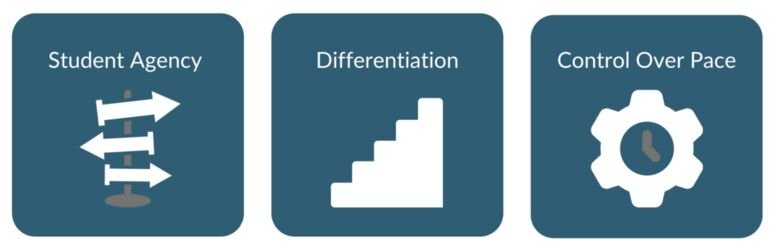
According to Tucker (2023), there are three critical pillars an educator should consider when designing for learning: student agency, differentiation, and control over the pace of learning. By incorporating these elements into the design of courses, educators can provide a more robust and impactful learning experience for themselves and their students:
- Student agency instills a sense of responsibility and ownership in students, fostering motivation through meaningful choices in their educational journey;
- Differentiation involves adjusting teaching methods to address students’ unique needs and abilities, supporting their learning journeys;
- Allowing students to regulate the pace of their learning helps them to control information acquisition and task completion, ultimately enhancing engagement and boosting their likelihood of success.

How does designing for learning contribute to quality?
Designing for learning fosters active, student-centred approaches that cater to diverse learner needs and encourage critical thinking, thereby enhancing the overall quality of teaching and learning. It ensures that educational experiences are tailored to meet the evolving needs of students and align with the latest advancements in pedagogy and technology.
Designing for learning will help you...
Focus on student learning:
- Designing for learning tailors instructional methods, content, and resources to meet their diverse needs and preferences;
- It promotes active engagement, deeper understanding, and the acquisition of essential skills
- It offers more flexibility because students can control when and where they learn. By self-monitoring their time and pacing, students are able to spend more time on unfamiliar or difficult content (Aslanian & Clinefelter, 2012).
Connect outcomes, teaching, and assessment:
- Designing for learning ensures that learning outcomes, teaching methods, and assessment strategies are aligned to create a cohesive educational experience where what is taught matches what is assessed and the desired learning outcomes;
- It enables the integration of ongoing formative assessment techniques within the teaching process, providing valuable feedback to both educators and students to adapt instruction and improve learning outcomes;
- It creates opportunities for students to receive, reflect on, and act upon feedback from educators, peers, and self-assessment activities throughout the learning process, supporting deeper learning and continuous improvement;
- It establishes a feedback loop, allowing educators to continuously adjust their teaching methods based on assessment results, helping students progress toward achieving the desired outcomes more effectively.
Improve the quality of teaching & learning:
- Designing for learning allows for personalised and differentiated instruction, tailoring the educational experience to individual student needs and preferences, thereby improving engagement and comprehension;
- It promotes active learning by incorporating interactive and engaging elements, such as collaborative activities, problem-solving tasks, and real-world applications, which enhance students' critical thinking and retention of knowledge.
The main shift is in the delivery of the session. Your primary role moves from delivering the content to facilitating and supporting the student's journey, through the digital content, through the learning activities and in supporting the self-directed study.
Reflective questions for learning design
Before designing a new course or reviewing an existing one, educators may find it useful to reflect on the following questions:
Learning outcomes
- What should students know, understand, and be able to do by the end of the course?
Learning activities
- How will students actively engage with key concepts through activities such as analysing, explaining, applying knowledge, or solving problems?
Feedback
- Where will students receive and use feedback from educators, peers, or self-reflection activities?
Assessment
- How do the assessments allow students to demonstrate achievement of the intended learning outcomes?
Student-centred design
- Where do students have opportunities for agency, choice, and control over aspects of their learning?
Inclusion and accessibility
- How does the design support diverse learners and create equitable opportunities for participation and success?
References
Related educational resources
 Photo: napkin.ai
Blended Learning Design
A step-by-step toolkit for designing quality teaching and learning sessions in blended course delivery. It offers practical guidance in learning design, helping you make intentional decisions about which aspects of your course are best suited for online versus face-to-face delivery.
 Photo: GettyImages
Canvas Course Design
This toolkit is designed to provide teachers at KI with real life examples of how to use Canvas to create content based on the six learning types in the ABC course design model.
You will be accessing this toolkit in the student role in Canvas.
 Photo: Erik Cronberg
ABC Online Toolkit
In this self-paced toolkit, you will be introduced to using the ABC model to plan your transition from previously face-to-face teaching in the classroom courses to delivery online, either asynchronously or synchronously.
Related courses
 Photo: Liza Simonsson
Courses to enhance your teaching skills
Are you a teacher, clinical supervisor or involved in education? If so, our spring courses are now open for registration. Come and join us to develop and deepen your pedagogical competence next term!
See more information about Higher Education courses and registration.