
Competence Framework for Researchers (ResearchComp)
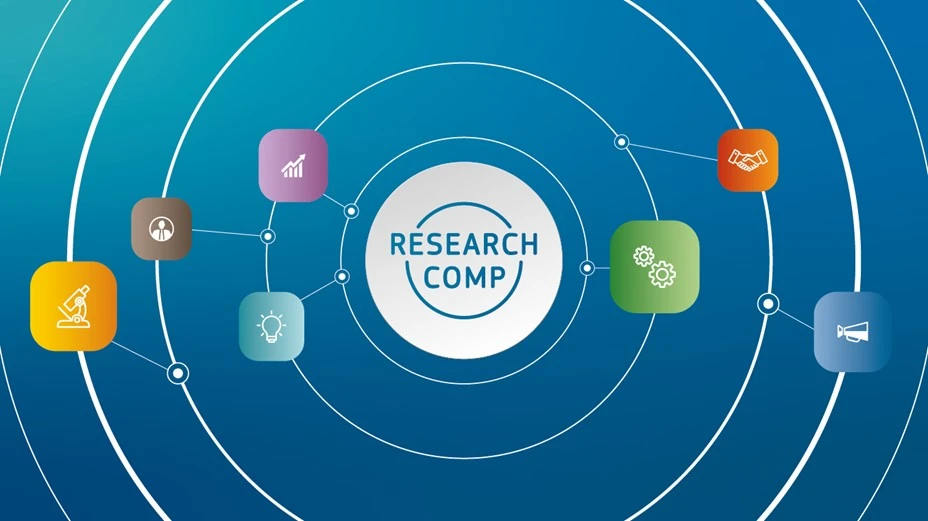
ResearchComp is the European competence framework for researchers. It provides a common approach to understanding, assessing and developing key competences across all career stages and supports career development within and beyond academia.
What is ResearchComp
ResearchComp is the European competence framework for researchers, developed by the European Commission in consultation with stakeholders across the research community. The framework provides a shared language and a structured overview of the competences needed to conduct high-quality, responsible and impactful research in academic and societal contexts.
ResearchComp helps researchers identify, develop and demonstrate key competences required for successful careers both within and beyond academia. It aligns with the goals of the European Research Area (ERA) and helps institutions strengthen researcher training, career development, and mobility.
For researchers, this provides a clearer understanding of the skills they need to develop, how to progress in their careers, and how to communicate their competences within and beyond academia.
How ResearchComp is structured
ResearchComp describes how competences develop across four levels of proficiency: foundational, intermediate, advanced, and expert, aligned with the progression represented by the European researcher profiles (R1-R4).
Researchers are not expected to reach the highest level in all competences. Instead, the framework supports continuous development through training, practical experience, and career progression.
Introduction to ResearchComp
This short video explains the ResearchComp framework and how it can be used in the career development of researchers, including the use of the self-assessment tool (SAT).
Research career stages: European researcher profiles (R1–R4)
In the Council Recommendation of 18 December 2023 on a European framework for research careers, researchers are grouped into four profiles regardless of their sector or employment context:
- First Stage Researcher (R1)
- Recognised Researcher (R2)
- Established Researcher (R3)
- Leading Researcher (R4)
R1 and R2 profiles correspond to early-career researchers, while R3 and R4 profiles correspond to more senior research roles. These profiles help researchers reflect on their current stage and identify relevant competence areas for development.
See how these profiles relate to academic roles and career progression at KI in the career structure for academic staff.
How ResearchComp can be used
ResearchComp can be used to support career development in several ways:
• Reflect on your current career stage (R1–R4)
• Identify strengths and areas for development
• Plan training and professional development activities
• Discuss career goals with a supervisor or manager
Researchers can also assess their competences using the ResearchComp self-assessment tool (SAT).
Support and opportunities to develop your competences at KI
After assessing your competences, you can develop them further through the following opportunities at KI.
Develop competences related to conducting high-quality research, from scientific methods and ethics to interdisciplinary collaboration and advanced tools.
Scientific methods and disciplinary expertise
- Doctoral course catalogue at KI
- Courses in statistics, experimental design, and advanced methodologies
Writing and publishing research
- Courses on scientific writing and publishing availabe in the Doctoral course catalogue at KI
- Support for preparing and disseminating research results: Communication tools and support at KI, Publication support and Strategic publishing by Karolinska Institutet University Library
Interdisciplinary research
- Doctoral programmes at KI Opportunities to collaborate across disciplines and research area
- SciLifeLab at KI A national research infrastructure and collaborative environment that brings together researchers from different disciplines and institutions to address complex research questions.
Research ethics and integrity
Advanced tools and methods (including AI)
- Centre for AI Innovation A collaborative environment supporting the development and application of artificial intelligence in research and healthcare.
- SciLifeLab at KI National research infrastructure providing access to advanced technologies, data science, and AI-driven methods.
- SciLifeLab & Wallenberg National Program for Data-Driven Life Science Support for data analysis, study design, and advanced statistical methods in research.
- Omics and high-throughput Access to cutting-edge technologies in areas such as genomics, proteomics, and bioinformatics, including support for experimental design and data analysis.
- KI RIMS A research information system that helps manage, analyse, and disseminate research data and outputs.
Develop competences related to planning, leading, and evaluating research, including funding, collaboration, and open science.
Mobilise resources
- Grants Office Support for identifying funding opportunities, preparing grant applications, and managing research funding.
- Research Support & Services Guidance on resources, funding schemes, and support services to facilitate your research projects.
Manage projects
- Research Support & Services Support for planning, coordinating, and managing research projects and collaborations.
- Data processing and extended statistical support Support for data management, statistical analysis, and execution of research projects.
Negotiate