

Annual follow-up
Progress in doctoral education must be followed up regularly to ensure that the degree outcomes are achieved in time for the public defence (or licentiate seminar).
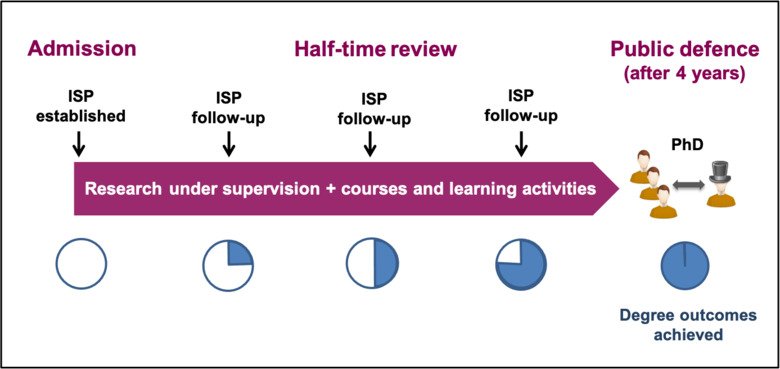
What is an annual follow-up?
An annual follow-up is conducted as a meeting between the doctoral student and the supervisor; see the checklist below. The purpose is to review in depth and follow up the doctoral student’s project, progress and development. What has been completed, and what remains? Does anything need to be replanned? Is the supervision working well? Is the timeplan realistic?
The discussion is based on the doctoral student’s individual study plan (ISP), in which updates and any changes are entered. The new version is then established by the department’s director of doctoral studies and becomes the new plan that the doctoral student must follow.
Please note that additional information about the first and the final annual follow-up is provided at the bottom of this page.
Preparations
- The doctoral student and principal supervisor schedule a follow-up meeting (co-supervisors and the mentor may also be invited) approximately one year after admission or one year after the previous annual follow-up. It is recommended that 2–3 hours be set aside.
- The doctoral student checks that completed courses, credit transfers, study activity and funding have been recorded and are correct. If not, contact the Ladok administrator.
- Both the doctoral student and the supervisor prepare by reviewing the study plan and noting the matters they particularly wish to discuss.
Follow-up meeting
The doctoral student and supervisor review the study plan and discuss the questions in the checklist below. They update and revise it as necessary.
Establishment of a new ISP version
- After the meeting, the doctoral student reviews the ISP and then approves a new version.
- The supervisor does the same.
- The director of doctoral studies reviews the ISP. If anything is unclear, incorrect, incomplete or questioned, the director returns the study plan to the doctoral student for further revision and renewed approval, after which it is sent back via the supervisor to the director of doctoral studies.
- Once the director of doctoral studies is satisfied, the study plan is established (even if revisions have been made, the study plan must be established again). Please note that until the new version has been established, the previous version remains in force.
- The director of doctoral studies opens a new version in the system in preparation for future updates.
- The co-supervisors are informed that a new version is available (they have read-only access in the system).
Checklist for the follow-up meeting
Basic information
Does “planned study activity and funding” correspond to “reported study activity and funding”? If not, why? Does the plan need to be revised? Read about reporting study activity and source of income.
- Remember that the doctoral student must find a mentor during the first year. The supervisor is welcome to suggest people, but the mentor should be entirely independent of the supervisors and the project. Please note that this is not included in the ISP, but it is nevertheless important. Read about mentors.
Supervisor
- Discuss how you think the supervision has worked so far:
- What are your expectations of each other?
- Are the roles and responsibilities of each supervisor described correctly and clearly in relation to how they work in practice? Does the description need to be updated? Is a discussion with the co-supervisors needed?
- Do the supervisors create a positive learning and work environment? How? Is it sufficient? Are any conditions missing that the doctoral student needs in order to develop as planned?
- Does the work environment need to be improved? In what way? Note that responsibility for the work environment rests with the doctoral student’s manager, who is not always the principal supervisor. However, supervisors contribute to the work environment in many ways and therefore still need to be involved in such discussions. Read more: Support for dialogue on doctoral students’ work environment and support functions for doctoral students.
- Revise the information if necessary. If the description of roles or supervisory responsibilities is changed, make sure that the co-supervisors concerned are informed.
Supervisor conversation
Annual follow-ups are to be documented here. You are also welcome to use this section for other types of meetings and check-ins between the doctoral student and supervisor, both planned and completed.
- Any comments on what has been entered so far?
- Discuss:
- How often do you meet? Is the frequency appropriate, and do the meetings meet your respective expectations? Do you discuss the learning process?
- Does anything about these meetings need to be improved?
Thesis work
Also open the uploaded Research plan document as a basis for this discussion.
- Research plan. Discuss:
- Are the research questions and hypotheses still relevant?
- Is the project following the research plan? Have any major surprises arisen, and if so, how have the problems been resolved?
- Do the preliminary results correspond to expectations?
- Do you need assistance with the project? If so, with what, and from whom or in what way?
- Is the ELN (electronic lab notebook) working satisfactorily? Read about the ELN.
- Planning and follow-up. Discuss:
- What has been completed so far?
- What needs to be done next?
- Is the timeplan realistic?
- Each part of the thesis work. Discuss:
- How is the writing process progressing? Who will be co-authors?
- Which journals are suitable for publication? Take the duration of the doctoral education into account and discuss alternative plans in case publication takes longer than expected.
- Ethical approvals
- Have all current approvals been uploaded?
- Are any additional ethical approvals required?
- Revise the research plan and the ISP if necessary. Upload the revised research plan and check that the summary in the ISP is still correct.
Courses and conferences
- If there are “unsorted certified results”, work together to identify which are mandatory and which are elective courses, and place them under the correct heading. If you wish, do the same with credits from other activities.
- Has anything already sorted been placed incorrectly?
- Have you planned for all mandatory course requirements? Note any comment made by the director of doctoral studies about course requirements in the Basic information section.
- Does the plan for courses need to be revised? Have new needs arisen? Note that the course offering varies from semester to semester.
More information about course requirements and course offerings:
General syllabus for doctoral education
Course requirements and choice of courses for doctoral students
Planned courses within the doctoral programmes
If you still have questions, contact the department’s director of doctoral studies.
Learning outcomes
Note that everything the doctoral student does within their doctoral education, including conducting the research project, taking courses and participating in other activities, must contribute to the doctoral student’s learning and achievement of the outcomes. All learning outcomes must be achieved before a degree can be issued.
- Discuss:
- What needs to be done to achieve each outcome? Read about how the outcomes can be achieved.
- Does the doctoral student receive sufficient training in research communication, nationally and internationally, both with other researchers and in other contexts?
- Are there opportunities to teach?
- How will the outcomes concerning interaction with the wider society be achieved?
- Record what has been completed and what remains by dividing the free-text field for each outcome into “planned” and “completed”.
- Are the planned activities still relevant? Revise them if necessary. (Also enter courses even though they appear in another section of the ISP. The purpose is to provide an overview of all activities and how they relate to the different outcomes.)
Timeplan
This section brings together information entered in other parts of the ISP.
- Discuss:
- Will the timeplan be met? What can be changed to ensure completion on time?
- Are the planned dates for the half-time review and public defence still correct? Read about the timing of the half-time review.
- If anything needs to be revised, return to the relevant section and revise it there (Timeplan and Overview are updated automatically). You are welcome to use the notes field.
Overview and reflections
The Reflections section allows the doctoral student to reflect regularly on their learning and thereby create a record of their development into an independent researcher. This will be helpful when the doctoral student writes their half-time report and the account of their learning before the public defence.
- Does the supervisor have any comments on the doctoral student’s reflections?
- Has the supervisor or director of doctoral studies written anything that needs to be discussed?
Please note that when information was migrated from the old ISP system in 2026, information previously entered under the old Comments tab was placed here, which may make it more difficult to use the section for the purpose described above.
Annual follow-up in the first year: meeting with the director of doctoral studies
In connection with the first annual follow-up, all doctoral students must be offered the opportunity to meet with the department’s director of doctoral studies. The meeting may be held in a group or individually. Its purpose is to identify any uncertainties, ensure that the doctoral education has started as planned and establish contact between the director of doctoral studies and the doctoral student.
The final annual follow-up
When approximately one year remains until the public defence:
- Discuss the timeplan:
- How much work remains?
- Is there enough time to complete everything? If not, consider whether the plan can be revised. If you need help, contact the department’s director of doctoral studies.
- If this has not been discussed earlier, it is time to discuss the doctoral student’s future career:
- Has the doctoral student planned the next step in their career?
- What guidance or advice can the supervisor provide?
- Is there anything the doctoral student can do to support their future career, such as courses, contacts, a research visit or networking?
Questions
Questions about the annual follow-up: Contact the director of doctoral studies at the department.