

About KI RIMS
This page provides an introduction to KI RIMS, KI’s research information system. It describes the system’s functions, the data sources on which the information is based, and how the system is managed.
What is KI RIMS?
A Research Information Management System (RIMS) is a system that manages research information, and its purpose is to collect, improve and make the information about the university's research available. The system chosen by KI is Symplectic Elements, a software service provided by the UK-based company Symplectic, which is part of the company Digital Science.
How does KI RIMS work?
KI RIMS has three main functions: aggregation, refinement and public dissemination. Data is retrieved from other systems both within and outside the university and is automatically linked, making it easier for KI researchers to keep information about their own and their group’s research and publications up to date. Information can also be added and updated manually.
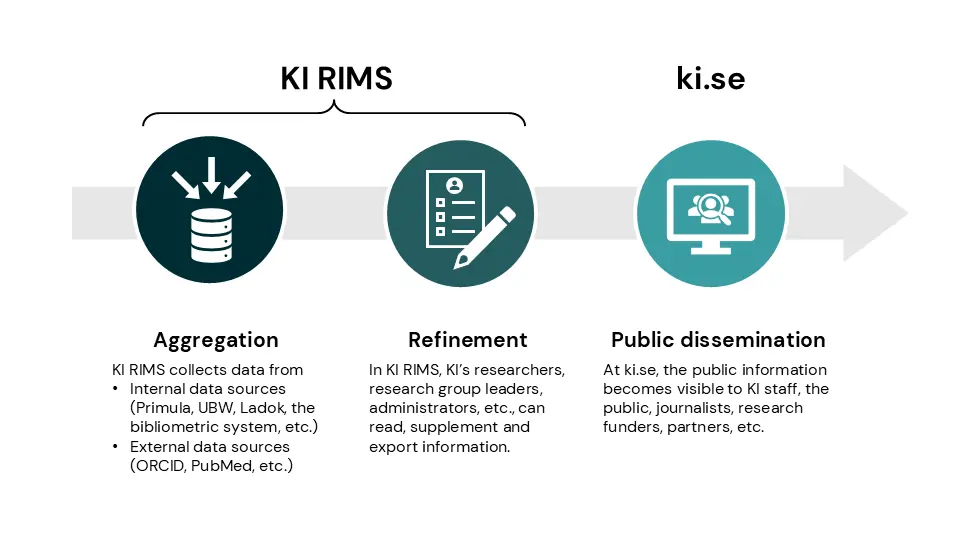
KI RIMS brings together information about people and groups affiliated with KI, as well as their publications and research grants. Through an integration with KI’s website, this information is displayed on profile and group pages and is therefore searchable via external search services such as Google, as well as through KI’s search service for research information. The information in KI RIMS can also be reused for various types of reports, such as publication lists.
Data sources for KI RIMS
KI RIMS automatically retrieves information from several internal data sources at KI:
- From IDAC names, telephone numbers, and email addresses are collected.
- From Primula / UBW Anknutna employments / affiliations, group memberships, and docentships at KI are collected.
- From Primula information about groups at KI and their hierarchical structure are collected.
- From Ladok degrees awarded by KI are collected.
- From the Bibliometric system scientific publications, as well as people's research areas and current USV-units, are collected.
- From KI Open Archive KI theses are collected.
- Data sets from the KI Data Repository are retrieved via Researchdata.se.
KI RIMS also contains large amounts of information from several external data sources that either show up as suggestions for publications or research grants under Pending or enrich already claimed items with both richer and more types of metadata:
- Bibliometric parameters (that are shown in some of the reports) can be collected from: Web of Science, Dimensions and Europe PMC.
- External research grants can be collected from: Dimensions
- Publications can be collected from: PubMed, Europe PubMed Central, Web of Science, Dimensions, Crossref and others.
KI RIMS depends on the data quality in other systems and the systems’ possibility to data integration. At present, it is not possible to integrate everything on the wish list, but development is ongoing.
The bibliometric system and KI RIMS
Even if much of the information in the bibliometric system is transferred to KI RIMS, the bibliometric system will continue to be used for resource allocation and publication analysis for the foreseeable future. It is therefore still important to verify all your publications in the bibliometrics system.
The bibliometric system
- has higher data quality
- is used for publication analyses and resource allocation
- only contains publications from PubMed and Web of Science from 1995.
KI RIMS
- has high, but not infallible, data quality
- is used to make research information visible, findable, and reusable
- includes a wider range of publication types from more sources, and allows publications to be added manually.
KI RIMS management organisation
KI RIMS is managed within KI’s digitalisation portfolio, where it forms part of the programme for Communication and Information Management. The management organisation includes representatives from several departments within the Professional Services and is coordinated by the University Library.
In the KI RIMS object steering group, there is equal representation from researchers and heads of technichal/administrative staff.
The purpose of KI RIMS is to create a coherent systems support for research information at KI, so that adequate, up-to-date and accurate information about KI’s ongoing and completed research and researchers will be easily accessible to both external and internal users. Among other things, this means that:
- It should be easy to find up-to-date and relevant information about KI researchers and ongoing or completed KI research, both internally and externally.
- KI researchers should be able to achieve increased dissemination of information about their research without increased administration.
- There should be overviews of KI’s ongoing and completed research, presented in a way that is both relevant and pedagogical.
- It should be faster to obtain relevant decision/analysis bases related to KI’s research and researchers.